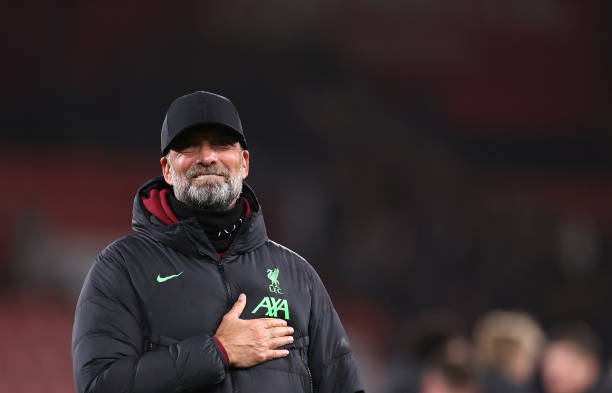
From chest-tightening bus rides to Central Park pretzels, Jürgen Klopp explains why “Head of Global Soccer” is not a consolation prize—and why the touchline may never see him again.
1. A Saturday That Didn’t Feel Like Work
Jürgen Klopp’s alarm in his Manhattan hotel still exploded at 5:30 a.m.—“jet-lag is a better coach than I ever was,” he jokes—but everything that followed was gloriously optional. Over the next fourteen hours the 58-year-old:
-
Streamed RB Omiya Ardija’s 4-3 comeback in Japan’s J2-League on his phone
-
Switched to RB Leipzig’s 1-0 win at Wolfsburg while brushing his teeth
-
Power-walked Fifth Avenue, stopping to debate New York street hot-dogs versus German bratwurst
-
Circled Central Park twice, greeting strangers who shout “Yo, Kloppo!”
-
Scouts gummy-bear selection at Hudson River-side kiosks ahead of the Hudson River Derby
-
Smiled when he realised Liverpool had just lost at Crystal Palace
“Last year I would have been in the Selhurst Park dressing-room trying to explain that defeat,” he told CBS Sports over coffee in a quiet Midtown café. “Instead I’m eating pretzels in Central Park. Perfect decision.”
2. The Chest-Tightening Truth About Elite Coaching
Klopp’s January 2024 resignation announcement shocked world football. Liverpool were third in the Premier League, had just lifted the Carabao Cup, and the German was only 56—years younger than Sir Alex Ferguson or Carlo Ancelotti when they hit their stride. Privately, the decision had brewed for months.
-
Pre-match bus rides felt like “a closing chest—my body never understood it was only football”
-
Post-match pressers became “a thousand-percent responsibility” he could no longer carry
-
One more drop in the bottle, he says, “and it would have exploded, messy for everyone”
His immune system agreed. Within weeks of stepping away he was bedridden for a fortnight with the worst flu of his life—temperature spiking, curtains drawn, unable to lift his head. “My body finally said: enough. I listened.”
3. Red Bull: The Job That Isn’t a Stop-Gap
On 1 January 2025 Klopp officially became “Head of Global Soccer” for Red Bull. The title sounds corporate; the brief is not. He is tasked with:
-
Setting a unified tactical identity for eight clubs on four continents (four majority-owned, three minority stakes, one main sponsorship)
-
Scouting coaches the way clubs scout players
-
Approving—or vetoing—every managerial hire and firing
-
Keeping the “gegen-press” spirit alive from Salzburg to São Paulo
He insists the post is “not retirement with a lanyard.” Nor is it a waiting room for the Germany or Liverpool hot-seats. “I will not go back to daily coaching. Never say never, but never is pretty close.”
4. Talent-Pool Philosophy: Give Them Wings, Then Defence
Klopp divides his blueprint into two halves:
A. General philosophy
-
Turn Red Bull into the world’s most productive talent greenhouse
-
Sell the developed, reinvest in the next wave—accept that “we are not the biggest fish”
B. Playing philosophy
-
Build a defensive cage 70 metres from goal so teenagers can “fly” without fear
-
Universal back-four this season (good-bye five-at-the-back) to free wingers
-
Encourage nutmegs, back-heels, risk—because mistakes happen far from the keeper
He summarises it with Red Bull’s own slogan: “I want to give wings to people. Cheesy? Maybe. But I’ve wanted that since Mainz.”
5. Work-Life Balance by Design
Perks the 58-year-old now lists without irony:
-
Holidays when “we want, not when the FA Cup schedule allows”
-
Shared oversight with Mario Gomez; either can leave for a week “and the world doesn’t end”
-
Saturdays that end with grandchildren instead of Gary Neville’s post-match dissection
Yet the football diet remains obsessive. He still watches every Red Bull match, data-banks every training session and texts coaches “not as a judge, but as a sparring partner.”
6. Why Not a National Team?
Germany, England and the USA all circled Klopp during his sabbatical. He declined.
-
Club coaches jumping to country duty? “No clue why—they say it’s lighter, but I don’t see it.”
-
Julian Nagelsmann has his “biggest support” for 2026 World Cup glory
-
If Germany called post-tournament? “Intense job, huge honour, wrong moment.”
His criterion is simple: “I must be on top of my game. Right now I’m on top of a different game.”
7. FAQ: Everything Fans Keep Asking
Q. Is he technically retired?
A. No. He has a multi-year employment contract, travels weekly and supervises 150-odd matches a season. He just doesn’t stand in the technical area.
A. No. He has a multi-year employment contract, travels weekly and supervises 150-odd matches a season. He just doesn’t stand in the technical area.
Q. Could Liverpool tempt him back if the club struggles?
A. Highly unlikely. He repeats: “I miss nothing,” and FSG are aware of that stance.
A. Highly unlikely. He repeats: “I miss nothing,” and FSG are aware of that stance.
Q. Does he pick the transfers?
A. He signs off on strategic profiles (e.g., “pressing winger, 18-22, resale value”) but day-to-day recruitment stays with each club’s sporting director.
A. He signs off on strategic profiles (e.g., “pressing winger, 18-22, resale value”) but day-to-day recruitment stays with each club’s sporting director.
Q. Will Red Bull clubs all clone Liverpool’s 4-3-3?
A. Not clone—adapt. Salzburg may press higher, Leipzig may invert differently, New York may flip to 4-4-2 mid-game. Core principles (compact block, immediate counter-press) are non-negotiable.
A. Not clone—adapt. Salzburg may press higher, Leipzig may invert differently, New York may flip to 4-4-2 mid-game. Core principles (compact block, immediate counter-press) are non-negotiable.
Q. When will he next appear on a touchline?
A. Only in charity friendlies or if he accepts a ceremonial cameo. “I manage,” he laughs, “just from the stands.”
A. Only in charity friendlies or if he accepts a ceremonial cameo. “I manage,” he laughs, “just from the stands.”
8. Epilogue: The Bottle Is No Longer Full
Klopp once illustrated his final Liverpool months by bringing his palms together until they trembled—one more drop and the vessel bursts. Today the same hands gesture expansively over coffee in Manhattan. The bottle has breathing room, the chest no longer tightens and the only pressing he worries about is whether the pretzel stall in Central Park still has the salted ones left. For a man who gave football everything, “nothing” has never felt so fulfilling.